A Pair of George III Neoclassical Candelabras
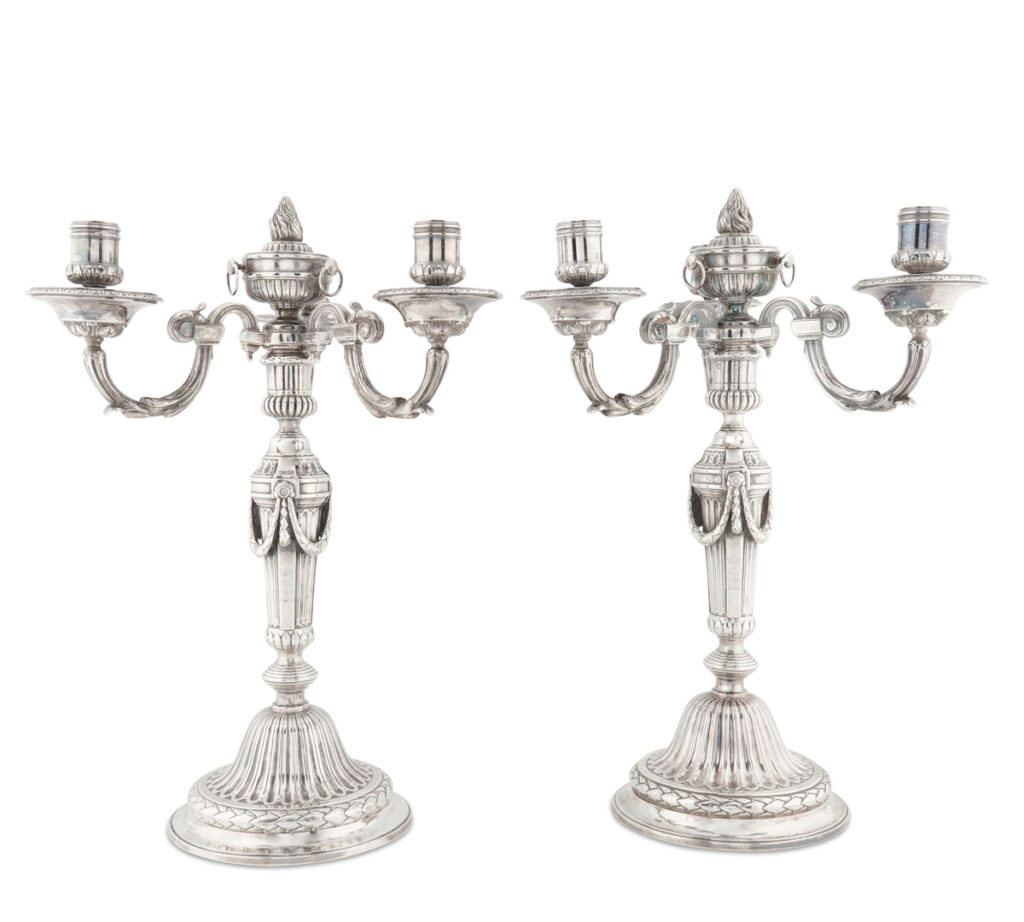
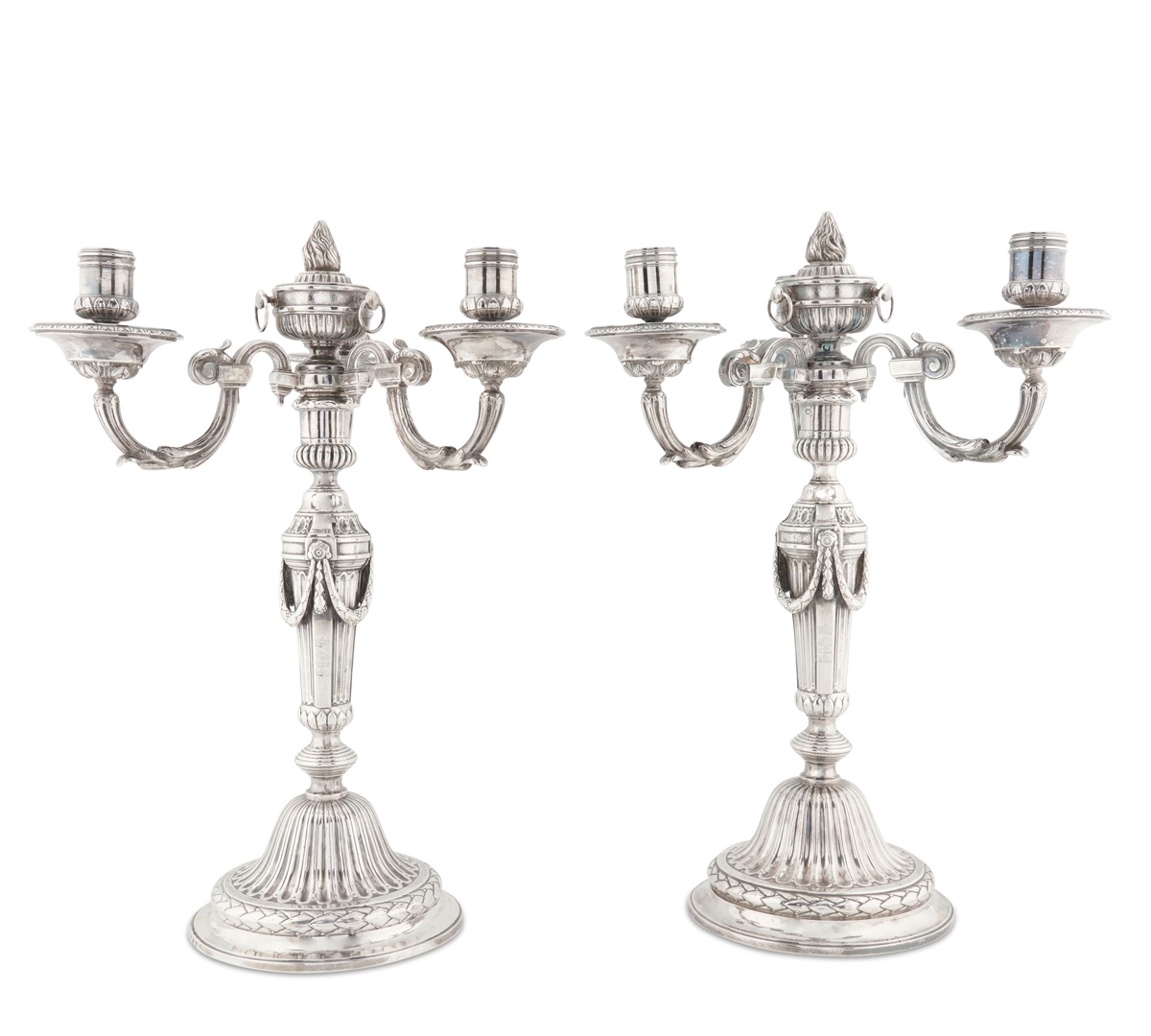
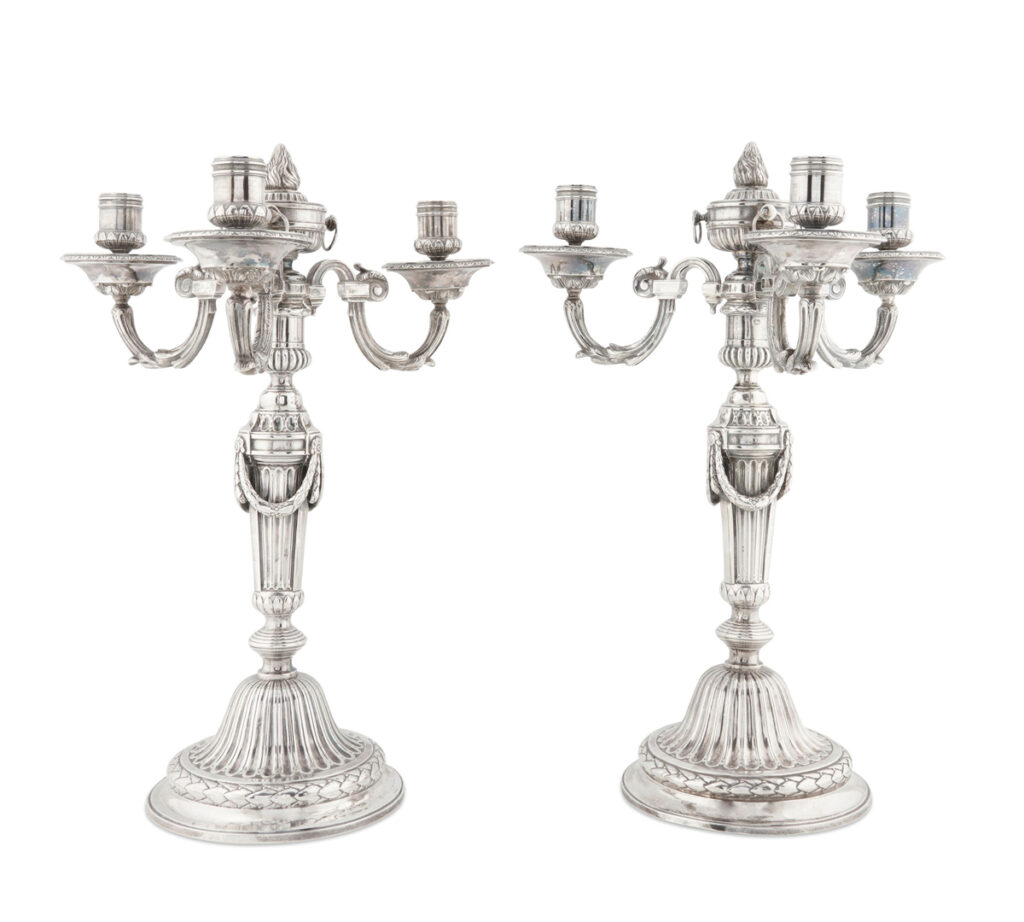
A pair of candelabras in the Louis XVl style by Robert Jones and John Schofield London, 1775-76 and 1777-78, H 15¼ in, 134.37 troy ounces or 4167g. The candelabra marked 1775, is marked underneath the base and has an additional lion passant and makers mark on the candle socket. The other candelabra dated 1777 is marked on the bottom side rim with an additional lion passant and makers mark also on the candle socket. The branches are unmarked, which was’t unusual during the time. Based on the set of four by the celebrated French silversmith Robert-Joseph Auguste in 1767, which were owned by The 1st Earl of Harcourt (1714-1777) who went to Paris as the ambassador of Great Britain in 1768. They were later sold on The Harcourt Collection, Sotheby’s, London, June 10, 1993, lot 103.
During this time, French styles were very popular in Great Britain among the aristocrats. This was the time when the rococo style was exhausted and a new style was coming in. This would be known as the neoclassical period, featuring the revived styles by the Greek and Romans.
Elegance and symmetry was again revived and Robert Adams designs were taking over interiors. These candelabras are exactly what would have been used in the finest of manors and palaces during this time. Featuring a beautifully fluted raised dome base with a band of laurel leaves around it and a cast fluted pillar with cast laurel swags around it with another laurel band around the top of the stick. With three finely cast leaf-capped scroll-form branches attached to deep wax pans with acanthus joins below spool-form sockets. All attached to a partly fluted urn with flame with three drop ring handles around it. This is the time period when styles like this were at the height of fashion.
The pillars are engraved with a crest featuring an oak tree on a ducal coronet with a frame saw through it and a marquis crown above the crest. These candelabras were with great certainty owned by the dukes of Hamilton (see Fairbairn’s Book of Crests of the Families of Great Britain and Ireland, plate 143, 8). Looking at the dates of the candelabras, they would probably have been owned the 8th Duke of Hamilton, Douglas Hamilton (1756-1799). He became the 8th duke at the age of 13 after the untimely death of his brother. In 1778 at age 21, he married Elizabeth Anne Burrell, who was the daughter of a minor politician. His mother was very much against the marriage and wanted him to marry into a more prominent family because of his high status. These candelabras were probably purchased either for or by him for his coming of age, or purchased by him for his wedding. The marquis crown on the pieces is uncertain, but probably has something to do with the political tension between England and Scotland.
These candelabras were sold on Christie’s in October 23, 2008, lot 199 (link) and twice on Bonham’s on June 10, 2025 (link) and October 21 2025 (link). The surprising thing about both of these auction houses, is that they didn’t mention that the candelabras featured the crest of the 8th Duke of Hamilton and they made no mention of their provenance. If they had, they would have likely sold for more. It’s interesting how things like that can be missed.